

As we head into fall, the Edmonton housing market is beginning to look different than it did during the busy spring months.
That doesn’t mean the market has suddenly become weak. But after several years when limited inventory often gave sellers a significant advantage, we’re seeing signs of a more balanced environment. One where buyers have more choice and sellers need to be increasingly thoughtful about pricing and presentation.
Here’s what the latest Edmonton housing market update tells us.

Sales Are Slowing as Inventory Builds
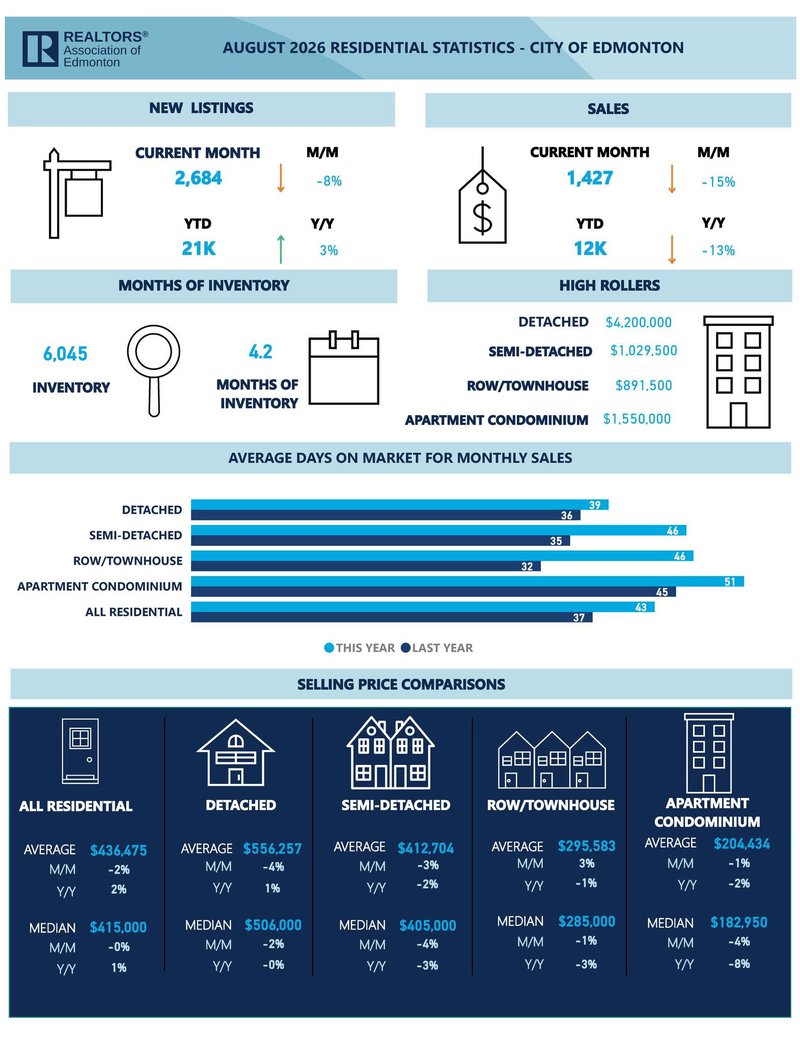
According to the REALTORS® Association of Edmonton, the Greater Edmonton Area recorded 2,143 residential sales in August 2026, down 15.4% from July and 9.8% from August 2025.
There were 3,769 new listings during the month. While that was down from July, it was 3.3% higher than a year ago.
Perhaps the number I’m watching most closely is inventory. At the end of August, there were 8,052 residential properties available, approximately 15% more than at the same time last year.
Some slowdown at this time of year is completely normal. However, when increasing supply is combined with declining sales, it tells us buyers have more options. And that changes the dynamics of the market.
Prices Are Holding, But the Picture Is Mixed
Despite softer activity, prices have remained relatively steady.
The average residential selling price across the Greater Edmonton Area was $469,602 in August, down 1.1% from July but still 1.8% higher than August 2025.
The MLS® Home Price Index composite benchmark was $426,900, down 0.6% both month-over-month and year-over-year.
The results also vary depending on what you’re buying or selling:
- Detached homes: $575,575 average price, up 1.0% year-over-year
- Semi-detached homes: $424,322, up 0.8%
- Row/townhomes: $298,238, down 1.2%
- Apartment condominiums: $215,422, down 1.2%
That’s an important reminder that there really isn’t one single “Edmonton housing market.” Property type, neighbourhood and price range can make a significant difference.

Homes Are Taking a Little Longer to Sell
The average residential property spent 41 days on the market in August, compared with 37 days a year earlier.
That may not sound dramatic, but it reinforces the broader trend: buyers generally have more time and more choice than they did in tighter market conditions.
For sellers, this means pricing a home based on where the market is today rather than where it was six months ago is becoming increasingly important.
What Does This Mean for Sellers?
There are still buyers in the market, and well-priced, well-presented homes continue to sell.
But sellers may need to adjust expectations. In a more balanced market, buyers are more likely to compare competing properties carefully, negotiate, and move past a listing they believe is overpriced.
Strong photography, thoughtful preparation, realistic pricing and experienced negotiation all become even more valuable when buyers have choices.
And What About Buyers?
For buyers, increasing inventory can create opportunities.
You may have more properties to consider, more time to make decisions and, depending on the segment, greater negotiating flexibility than you would have experienced during the height of the spring market.
That doesn’t mean every property will be negotiable. Desirable homes in sought-after neighbourhoods and price ranges can still attract strong interest.
Top Advice from Wally
The Edmonton housing market is shifting, but shifting does not mean there isn’t opportunity.
For sellers, the key is recognizing that strategy matters more as inventory increases. For buyers, it means taking advantage of greater choice without assuming every seller is under pressure.
If you’re thinking about buying or selling this fall, I’d be happy to help you understand what these broader numbers mean for your specific neighbourhood, property type and price range. Market averages are useful, but the best real estate decisions are always based on the market that applies to you.
Connect with Wally at 780.238.7384 to talk about your next move.